You need images for an article, a social post, or a mockup, but you don’t have a designer on hand. Or you need hundreds of product variants and hiring a photographer for each is out of budget. DALL-E 3 turns descriptions into images — but using it well is not automatic. We’ll show you how to generate images that serve your business, not just look pretty.
We are Meteora Web. We work daily with businesses that need visual content without breaking the bank. Coming from accounting and e-commerce operations ourselves, we know that an AI-generated image costs pennies via API vs. tens of euros for a freelance designer — but if it doesn’t match your brand, it’s wasted money. This guide walks you through using DALL-E 3 effectively, both via ChatGPT and the API, with real code and actionable steps.
What is DALL-E 3 and Why It’s Different
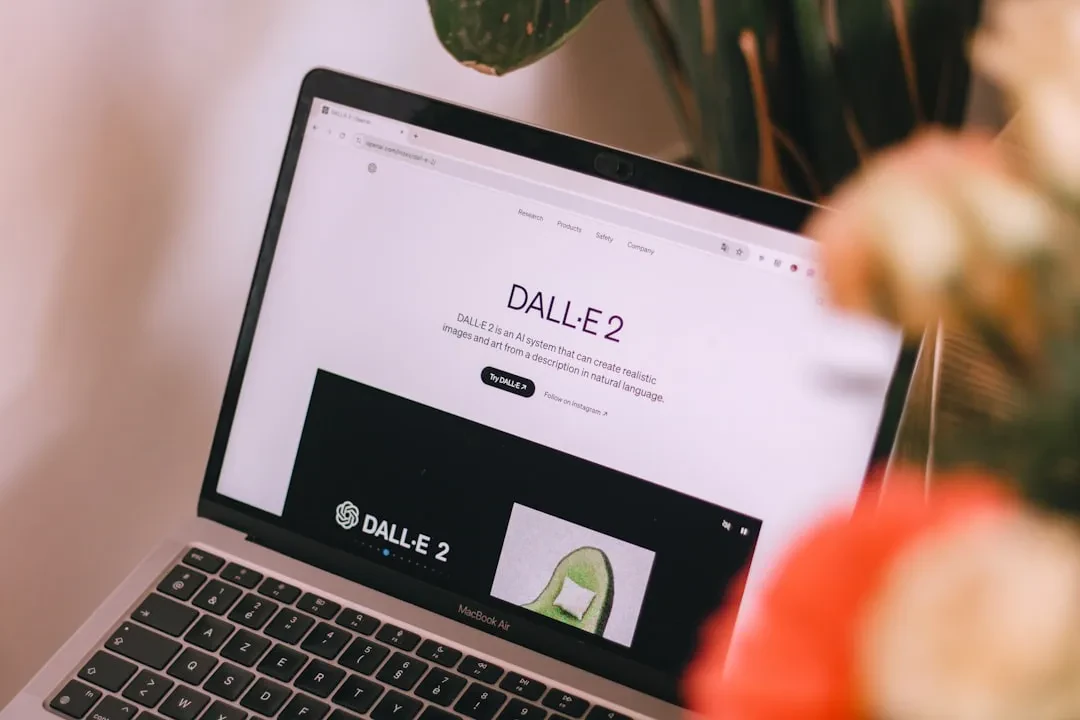
DALL-E 3 is OpenAI’s text-to-image model. Its key advantage over Midjourney or Stable Diffusion is native integration with ChatGPT: you describe an idea in natural language, and ChatGPT refines it into an optimized prompt — no need to learn special syntax.
The real difference? DALL-E 3 understands context better. Ask for “a cat reading a newspaper in a Palermo café,” and it gets the setting right (colors, furniture, Mediterranean light). Other models often produce disjointed elements. For a business that needs production-ready images, this coherence saves hours of editing.
When to Use ChatGPT vs. the API
If you need a few creative images (social posts, concepts, moodboards), use ChatGPT: type your request, it refines the prompt, click “Generate.” No code. Perfect for marketers and content creators.
If you need to automate production (e.g., product images for a 1000‑SKU catalog), use the OpenAI API. You can generate hundreds of variations with a script, enforce consistent styles, and integrate everything into a workflow — exactly what we do when building platforms for our e‑commerce clients.
Generating Images with ChatGPT: Practical Techniques
Quality starts with the prompt. Don’t ask for “a modern chair.” Be specific: “an ergonomic office chair, grey and blue, white background, soft studio lighting, slight side angle.”
Our proven workflow:
- Describe subject and context (what, where, mood).
- Specify style (photographic, 2D illustration, pixel art, low poly, etc.).
- Add technical constraints (transparent background, 16:9 ratio, close‑up).
- Ask ChatGPT to improve the prompt: “Rewrite this description as a DALL-E 3 prompt, adding details about light, composition, and style.”
- Generate and iterate: if the result isn’t right, modify the prompt by adding what’s missing.
Real example: For a furniture e‑commerce client, we generated product images with consistent backgrounds using ChatGPT. Just describe the piece and the room style. Result: 50 usable images in an hour, instead of two days of photoshoot. Cost? Zero (ChatGPT Plus subscription), only revision time.
Action item: Try it now with ChatGPT
Open ChatGPT Plus, enable the GPT-4 model with DALL-E (the “Create images” banner), and write a prompt for an image you actually need for your work. Iterate three times until you get something close. Note which tweaks worked — those become your reusable prompt library.
Generating Images with the OpenAI API: Code and Costs
The API gives you fine control: you can set quality (standard or HD), size (256x256, 512x512, 1024x1024, 1792x1024), and number of variants. Pricing per image ranges from $0.016 for 256x256 to $0.120 for 1792x1024 HD. For a small business generating 1000 images per month, that’s tens of dollars — negligible compared to a photographer.
Here’s the Python code to generate an image with the OpenAI API:
import openai

client = openai.OpenAI(api_key="your_api_key")

response = client.images.generate(
    model="dall-e-3",
    prompt="A red wool sweater on a white background, studio lighting, 2:1 aspect ratio",
    size="1792x1024",
    quality="standard",
    n=1
)

image_url = response.data[0].url
print(image_url)
In a few seconds you get the image URL. You can download it and save it to your server. We integrated this into a proprietary platform for a client with 5000 SKUs: the script generated missing images nightly, uploaded them to Cloudinary, and linked them to SKUs in the database. Development time: half a day. Estimated annual savings: over €20,000 in photography costs.
Key parameters to know
- model: set to "dall-e-3" (the only current model for high‑quality images).
- quality: "standard" for most cases, "hd" for fine details (costs double).
- size: choose based on final format. For social 1:1 use 1024x1024, for vertical site hero 1024x1792, for banner 1792x1024.
- style: "vivid" (more saturated, contrasty) or "natural" (more realistic). For product shots on white, choose "natural".
response = client.images.generate(
    model="dall-e-3",
    prompt="White running shoes on wooden floor, natural light, photographic style",
    size="1024x1024",
    quality="hd",
    style="natural",
    n=1
)
Action item: set up a test environment
Create a Python file, install the library with pip install openai, paste your API key (from the OpenAI dashboard), and run the script above. Generate a test image, download it, and verify it meets your needs. Check the cost in your OpenAI account — you’ll see that for a few cents you have a production‑ready image.
Common Mistakes and How to Avoid Them
1. No transparency. DALL-E 3 does not generate PNGs with transparent backgrounds natively. Use a tool like remove.bg or automate it with Python libraries (rembg). We automate this: after generation, the image goes through a pipeline that isolates the subject.
2. Brand inconsistency. If you ask for “company logo,” DALL-E 3 may write wrong text or invent colors. Don’t use it for final logos. Use it for concept art that a graphic designer will polish. For our clients, we generate moodboards, then hand them off to the designer.
3. Rights issues. OpenAI grants commercial rights to generated images (per their terms), but does not guarantee that the image doesn’t resemble copyrighted works. For safe commercial use, avoid prompts imitating famous artists’ styles or including registered trademarks.
4. Resolution bottlenecks. DALL-E 3 maxes out at 1792x1024. For print or large formats, you’ll need upscaling tools like Topaz Gigapixel or specialized APIs. Plan the final format upfront.
Concrete Use Cases for SMEs
- E‑commerce: Generate product images on neutral backgrounds, color variants, and scenes. We built a system that, given a product CSV, automatically generates images and uploads them to WooCommerce. Result: zero stock photos, fully customized, negligible cost.
- Social media: Create visual posts with integrated text (then refine in Canva) to maintain a steady posting cadence. Use ChatGPT to write the prompt and generate the image in one flow.
- Business websites: Generate hero images and section backgrounds that align with the brand tone. Just a descriptive prompt of the business sector.
In summary – What to do next
- If you’ve never used DALL-E 3, start with ChatGPT Plus: describe an image you actually need and iterate until you get a satisfactory result. Learn to write specific prompts.
- If you need to automate production, set up the OpenAI API with a Python script like the one above. Test with a batch of 5 images. Calculate costs (pennies per image).
- Integrate generation into your workflow: for e‑commerce, connect your product CSV to the script and schedule weekly runs.
- Don’t skip post‑processing: background removal, upscaling, and manual quality checks on a sample.
- Track results: how much money did you save? How much time? We think in numbers — a generated image that isn’t used is wasted; one that drives conversions is an investment.
For more on building AI automation for your business, see our guide on AI automation for SMEs. And to understand the risks of careless AI use, read our analysis on Meta’s AI assistant being used to steal accounts.
Sponsored Protocol